Blog
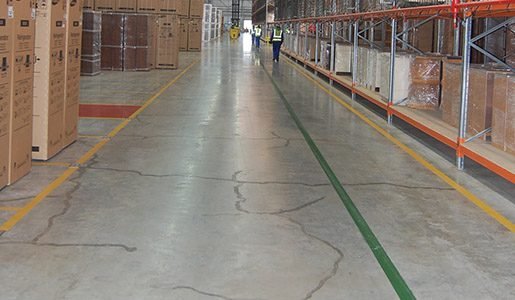
Most garage floor cracks are shrinkage or settlement cracks that can be repaired. Clean and widen the crack, vacuum it, fill it with a rigid epoxy or polyurea crack filler, and grind it flush. Cracks that keep widening, are uneven on each side, or let water in may signal a structural or drainage issue and should be looked at by a pro.
Almost every garage slab in the Chicago area has cracks. Freeze and thaw cycles, road salt and normal concrete shrinkage all play a part. Most are cosmetic and fixable. The goal is to fill them so they stay closed and do not telegraph through a new coating.
Types of garage floor cracks
| Crack type | What it looks like | Concern level |
|---|---|---|
| Hairline shrinkage | Thin, random, even on both sides | Low |
| Control joint cracks | Straight lines at saw cuts | Normal by design |
| Settlement cracks | Wider, may be slightly uneven | Medium; monitor |
| Heaving or displaced | One side higher than the other | High; get an assessment |
| Spalling | Flaking, pitted surface near cracks | Medium; often salt related |
Tools and materials
- Angle grinder with a crack-chasing diamond blade
- Shop vacuum
- Two-part epoxy or polyurea crack filler (rigid for coating prep)
- Putty knife or margin trowel
- Silica sand for wider cracks
- Safety glasses, dust mask or respirator, gloves
Step by step: fixing a garage floor crack
- Chase the crack. Use a crack-chasing blade to open it slightly into a clean V so the filler can grab both sides.
- Clean it out. Vacuum all dust and debris. Oil or salt residue must be removed.
- Fill wider cracks with sand. For cracks deeper than about a quarter inch, a little silica sand helps support the filler.
- Apply the filler. Mix the two-part filler and work it into the crack, slightly overfilling.
- Let it cure. Follow the product timing; polyurea fillers cure quickly.
- Grind flush. Grind the repair level with the surrounding floor so it disappears under a coating.
Want a written number for your garage?
Free on-site measure and moisture test.
Flexible vs rigid fillers
Flexible sealants suit control joints and moving cracks on bare concrete. Under an epoxy coating, a rigid filler is usually preferred so the coating does not dip or crack over a soft spot.
When to call a pro
- Cracks wider than about a quarter inch or getting wider.
- One side of the crack is higher than the other.
- Water comes up through cracks.
- You plan to coat the floor and want a seamless finish.
We repair cracks as part of every coating job. Learn why in why professional crack repair matters, or see our crack repair service.
Will cracks come back under epoxy?
Active cracks from ongoing movement can reflect through any coating. Shrinkage cracks that are properly repaired usually stay hidden. More in why epoxy floors peel.
This article is part of our guide to fixing and preparing concrete floors.
Frequently asked questions
What is the best filler for garage floor cracks?
For floors that will be coated, a rigid two-part epoxy or polyurea crack filler is the usual choice.
Should I fix cracks before epoxy?
Yes. Cracks should be repaired and ground flush before any coating goes down.
Are garage floor cracks normal?
Hairline shrinkage cracks are very common and usually not structural.
When is a garage floor crack serious?
When it keeps widening, one side is higher, or water comes through. Get it assessed.
Epoxy, flake, metallic and polished concrete installers serving Chicagoland since 2006. Every article is written from what we see on real slabs.
Get a written number for your floor.
On-site measure and moisture test at no cost.
(773) 908-4913Request Estimate